

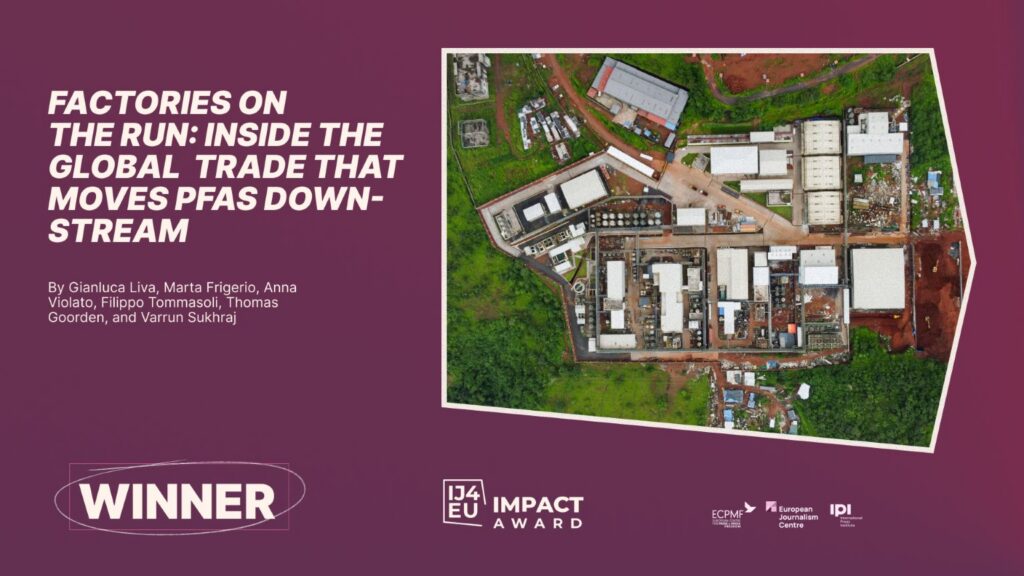
Factories on the Run traced what happened to the Miteni factory in the northern Italian city of Vicenza, which had contaminated drinking water in the region with PFAS chemicals.
PFAS are a family of synthetic chemicals used in products ranging from non-stick cookware to waterproof clothing. Known as “forever chemicals”, they are highly persistent in the environment and have been linked to serious health risks.
Former executives of the company were eventually sentenced to a combined 141 years in prison.
But a six-person team of freelance journalists found that the factory itself had been dismantled, shipped to India and rebuilt, with production restarting in 2023 using the same toxic chemistry for the same buyers.
The jury praised the investigation for turning an abstract issue into concrete evidence, showing how hazardous industrial activity shut down in Europe could be moved elsewhere rather than disappear.
The reporters traced the machinery from Italy to an enormous industrial enclave in western India, documenting how environmental risks rejected in Europe could be transferred to the Global South.
The findings were later cited in environmental and public-health research.
The investigation also prompted a backlash in India, where lawmakers demanded that the plant be closed, residents protested outside its gates and a petition was launched against the import of banned chemicals.
Juror Neus Vidal, executive director of the Seek Initiative, highlighted the fact that six freelance journalists had produced reporting with consequences spanning two continents and reaching a national parliament.
“What stood out was how much a small team achieved across borders,” Vidal said. “A small group of freelance journalists followed this story from Italy to India, and this is what we mean when we talk about impact: the publication showed the harm that was done, but it also changed the conversation in the place where the harm was happening. Not many investigations, let alone ones this size, can point to that kind of reaction.”