

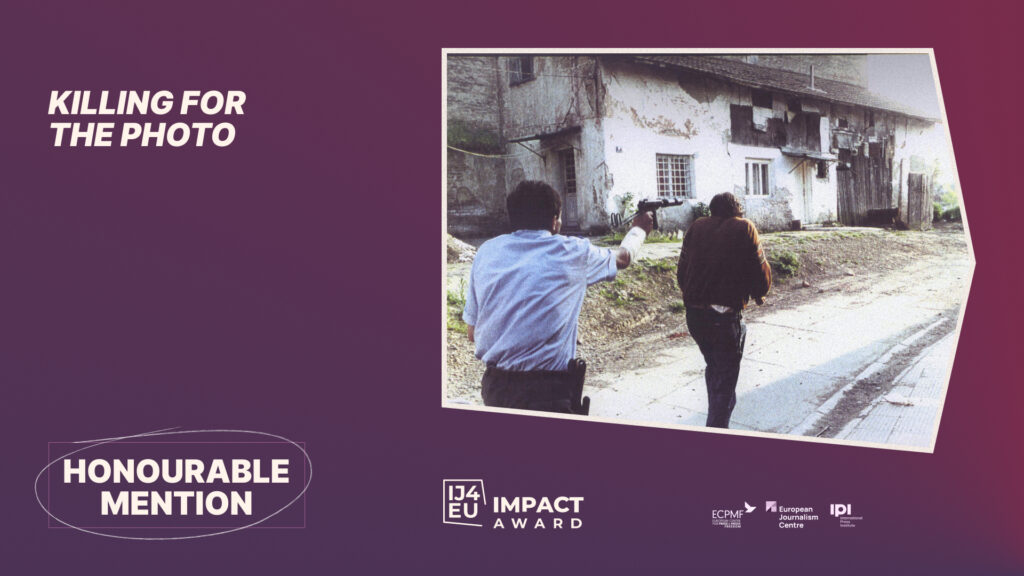
The jury gave special recognition to Killing for the Photo by Barbara Matejčić in collaboration with Natalija Jovanović and Ruben Brugnera.
Published by the Balkan Investigative Reporting Network in Serbia and Novosti weekly magazine in Croatia, the investigation revisited photographs showing a Bosnian Serb paramilitary executing a civilian in Brčko in 1992.
It examined whether the photojournalists who recorded the killing were simply witnesses or whether their presence played a role in what happened.
The photojournalist, who later won a World Press Photo award and received asylum in the Netherlands, came to be regarded as a journalistic hero.
But the caption accompanying the winning image wrongly identified the murdered civilian as an armed sniper and remained uncorrected for 30 years. The investigation led to the caption being corrected.
The jury described Killing for the Photo as one of the most uncomfortable investigations it reviewed this year because of the questions it raised about journalism’s own possible shortcomings — questions that remain highly relevant to how journalists are documenting the current wars in Ukraine and Gaza.
They also highlighted the project’s persistence in returning to events decades later and seeking accountability.
Can Ertuna, a journalist and associate professor in the Faculty of Communications at Bahçeşehir University in Istanbul, said that persistence showed how journalism could contribute to justice and, potentially, some measure of healing for victims and their families.
“This investigation also exposes the gaps that even organisations regarded as standard-setters in journalism may have in verifying information and news, underscoring once again the importance of applying universal journalistic principles regardless of location or context,” Ertuna said.